Performance Guides
Hero Xpulse 200 4V and 210 Upgrades (2026): What Fits Which Bike, and What Is Actually Worth It
A straight fitment guide to upgrading the Hero Xpulse 200 2V, 200 4V, 4V Pro and Xpulse 210. Which parts fit which bike, the upgrades that genuinely change how each one rides, FuelX vs PowerTRONIC, and what we would skip.

The Xpulse is the bike Indian riders modify most and research least. Every week someone sends us a part number that fits an Xpulse, just not theirs. A 200 4V crash guard will not bolt onto a 210. The 210 spark plug is not the 4V spark plug. Even the rally towers are different parts. So before we talk about what is worth buying, we need to settle which Xpulse is actually in your garage.
This guide covers the Xpulse 200 (2V), the 200 4V, the 200 4V Pro and the Xpulse 210: the upgrades that genuinely change how each one rides, and the ones we would tell you to skip. Every part named here is one we stock with fitment data behind it. If a part is not listed for your variant, we say so. If you would rather browse than read, the full range sits in our Hero Xpulse 200 and 210 upgrades collection.
Which Xpulse do you actually have?
Hero has sold four distinct Xpulse 200-class bikes since 2019, and they share far fewer parts than their names suggest. The 210 in particular is close to a new motorcycle: a liquid-cooled engine borrowed from the Karizma XMR, a six-speed gearbox, a new subframe and longer suspension.

The Xpulse 210: new liquid-cooled engine, new subframe, and very few parts shared with the 200 4V.
| Spec | Xpulse 200 4V | Xpulse 200 4V Pro | Xpulse 210 |
|---|---|---|---|
| Engine | 199cc, oil-cooled, 4-valve | 199cc, oil-cooled, 4-valve | 210cc, liquid-cooled, 4-valve |
| Power | 19.1 hp at 8,500 rpm | 19.1 hp at 8,500 rpm | 24.6 hp at 9,250 rpm |
| Torque | 17.35 Nm at 6,500 rpm | 17.35 Nm at 6,500 rpm | 20.7 Nm at 7,250 rpm |
| Gearbox | 5-speed | 5-speed | 6-speed |
| Suspension travel (front / rear) | 190 mm / 170 mm | 250 mm / 220 mm | 210 mm / 205 mm |
The two-second check: if your bike has a radiator and a sixth gear, it is a 210. If it has an oil cooler and five gears, it is a 200 4V, and the long-travel Pro is the one with the taller seat and the rally suspension. The original 2-valve Xpulse 200 (2019 to 2021) uses its own spark plug and its own fuel-module harness, so treat it as a separate bike too.

Radiator (left) or oil cooler (right): the quickest way to tell a 210 from a 200 4V.
One more detail matters if you plan to fit a fuel module: some 2024 Xpulse 200 4V bikes run two oxygen sensors to meet the newer OBD2 norms, and FuelX sells a dedicated "Dual O2" version for them. Tell us your registration year when you order and we will match the right harness.
The upgrades that genuinely work
1. Brake pads first, not last
The most common complaint we hear from Xpulse owners is not power. It is a front brake that feels wooden. Autocar India's long-term Xpulse 210 had the same issue: the reviewer still found the brakes short on bite and feel after the service centre bled the system. A change of pad compound is the cheapest way to fix that, and it is the only upgrade on this list that makes the bike safer on day one.

Ceramic pads (left) for quiet, clean city braking; sintered pads (right) for mud, rain and long descents.
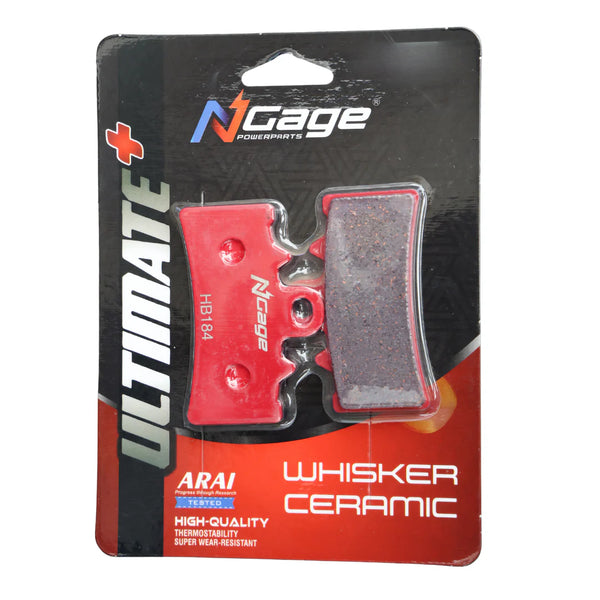
- Front, all 200 and 210 models: NGage HB 008 / HBS 008 front brake pads. Pick the sintered HBS version if you ride in rain, mud or on long descents.
- Rear, all 200 and 210 models: NGage HB 104 / HBS 104 rear brake pads.
- Strongest bite, 200 4V / Rally / 210: 66BHP Race Pro sintered brake pads. These are sourced to order and take two to four weeks. They are aggressive, which is exactly what you want off-road and a little more than you need for pure city riding.
- Quiet, low-dust rear option for the 200: Vesrah SD-182 ceramic rear pads.
Whatever you fit, bed the pads in properly: a dozen moderate stops from 40 to 10 km/h before you trust them hard. If you are torn between ceramic and sintered, our guide to the best brake pad brands in India covers the trade-off in detail.
2. A spark plug matched to your engine, not your badge
An iridium plug will not add horsepower, and anyone who tells you otherwise is selling something. What it does is give a stronger, more consistent spark over a much longer life, which shows up as cleaner cold starts, a steadier idle and smoother low-rpm pick-up. That last part matters on an Xpulse, where you spend half your trail time at walking pace.
The catch is that the three engines take three different plugs:
- Xpulse 200 2V and 200T 2V: NGage B8RII-8 double iridium
- Xpulse 200 4V and 4V Pro: NGage BN8RTIIA-9 double iridium, or the complete NGage high-performance spark plug kit if you want the cap and lead as well
- Xpulse 210: NGage VH8RTII-9 double iridium
For how heat range and plug codes work, see our iridium spark plug guide.
3. A high-flow air filter, if you will actually clean it
A washable performance filter lets the engine breathe more freely and pays for itself over the life of the bike, because you stop buying paper elements. But the Xpulse is a dust bike, and that changes the rules. A performance filter that is ridden through a dusty trail weekend and never cleaned will flow worse than the paper filter it replaced.

One dusty trail weekend can choke a filter. A high-flow filter only helps if you keep it clean.
- Xpulse 200, 200 4V and 200 2T (BS4 and BS6): NGage Hyper Flow air filter
- Xpulse 210 (2025 onwards): NGage Hyper Flow air filter NGAGE-022XPUL210
- Xpulse 200 (2019 onwards), premium option: BMC FM01156 air filter
Our rule for Xpulse riders: inspect the filter after every off-road day and clean it whenever you can see the dust layer. Our performance air filter guide explains how BMC and NGage compare.
4. An exhaust: full system on the 4V, slip-on or full system on the 210
A good aftermarket exhaust sheds weight, gives the bike a proper voice and frees up a little top-end. It will not turn a 19 hp engine into a 25 hp one, and you should be suspicious of any listing that implies it will. The real benefit comes when the exhaust is paired with a fuel module (next section), so the engine is fuelled correctly for its new breathing.
- Xpulse 200 4V: Powerage full system exhaust
- Xpulse 210, slip-on: Powerage slip-on with mid pipe or the Red Rooster Polaris slip-on
- Xpulse 210, full system: Norifumi Rocket4 Kompetisi full system with dB killer
Keep the dB killer in. A loud bike draws attention at checkpoints and from neighbours, and on a trail it is the fastest way to get an entire riding group banned from a route. If you are still choosing a brand, read our breakdown of the top exhaust brands in India.
5. A fuel module: FuelX Lite vs FuelX Pro+ vs PowerTRONIC
This is the part most Xpulse owners get wrong, usually by buying the most expensive option when the cheapest would do, or by skipping it entirely after fitting a filter and exhaust. The Xpulse's stock fuelling is tuned for emissions, which is why both engines can feel snatchy at low throttle openings. That is the exact place you live when you are picking a line through rocks.
| Module | Price | What it does | Listed fitment | Best for |
|---|---|---|---|---|
| FuelX Lite | Rs. 7,469 | Autotunes fuelling from the O2 sensor; plug and play | 200 2V (2020–21), 200 4V (2022–24), 200 4V Dual O2 (2024), 210 (2025) | Stock bikes or filter-only bikes that need smoother low-speed throttle |
| FuelX Pro+ | Rs. 13,449 | Autotune plus 10 selectable maps on a handlebar switch | 200 4V (2022–24), 200 4V Dual O2 (2024), 210 (2025) | Filter plus exhaust, and riders who switch between trail and highway |
| PowerTRONIC V4 | Rs. 21,469 | Piggyback ECU with adjustable fuel and ignition maps | 200 2V (2020–21), 200 4V (2021–24), 210 (2025) | A full Stage 1 build, dyno tuning, and riders who want ignition control |
Our honest recommendation: most Xpulse riders are best served by FuelX Lite or Pro+. Go to PowerTRONIC only when you have a filter and an exhaust fitted and want the map built around them. Because these modules adapt fuelling to conditions, they also earn their keep on high-altitude rides, where a stock bike runs rich in the thin air. If you are heading to Manali–Leh this season, that is worth knowing. For the difference between autotune modules, piggybacks and full remaps, read our explainer on engine tuning methods, and for how the parts combine into a staged build, see Stage 1, 2 and 3 kits explained.
6. A sealed chain kit for the mud
An Xpulse chain lives a harder life than almost any other in India: water crossings, slush and grit, followed by a highway run home. A sealed brass-plated kit resists corrosion far better than the stock chain.
- Xpulse 200 and 200 FI: Rolon brass chain and sprocket kit (HPORC 387)
- Xpulse 200 4V and Rally Edition: Rolon brass chain and sprocket kit (HPORC F411)
We do not have a listed Rolon kit for the 210 yet, so message us before you order anything for it. Our brass chain vs normal chain guide explains what the plating actually does.
Protection that pays for itself on the first fall
Every Xpulse goes down eventually. That is not a criticism; it is what happens when a bike gets ridden where it was designed to go. A crash guard costs less than a single replacement engine cover, and a bash plate costs less than a cracked sump. This is also where cross-fitting mistakes are most expensive, because a guard designed for one frame simply will not line up on another.
- Xpulse 200 / 200T (BS6): LCB Xplorer crash guard with slider
- Xpulse 200 4V Pro: LCB Defender crash guard in black, red or white, plus the LCB Vambrace aluminium bash plate and the LCB Vector radiator grill
- Xpulse 210: Legundary Xplorer crash guard
- Headlight protection: the LCB headlight grill, the LCB Cosmic headlight grill for the 4V Pro, or the clear LCB Oculus headlight shield if you want protection without blocking the beam pattern
Why a crash guard works, and why its mounting points matter more than its tube thickness, is covered in the science behind motorcycle crash guards.
Touring kit: rally tower, luggage and navigation
The 210's extra power and sixth gear make 90 to 100 km/h a comfortable cruise, which the 200 4V never quite managed. Once the engine stops being the limit, windblast becomes the thing that tires you out. That is what a rally tower is for: a proper screen, plus a solid cockpit mount for a phone or GPS where you can actually see it.

A rally tower moves the windblast off your chest and puts navigation in your line of sight.
- Rally tower, Xpulse 210: MotoCare Mantis rally tower windshield with clamp kit
- Rally tower, Xpulse 200 4V: MotoCare Mantis rally tower windshield with clamp kit
- Luggage, Xpulse 210: Legundary Gopher luggage carrier, Legundary Xtruder saddle stay and the Legundary Ploigos GPS mount
- Luggage, Xpulse 200: the LCB Xtruder saddle stay, an LCB carrier plate (small, big or the BS4 / BS6 version), and the LCB pillion backrest
Saddle stays decide what bags you can run, so choose your luggage first. Our hard vs soft panniers guide will help you decide.
What we would skip
- Buying by the word "Xpulse". Search results and marketplace listings routinely lump the 2V, 4V, 4V Pro and 210 together. Check the variant, not the name.
- An exhaust without a fuel module. It sounds better, but on a fuel-injected engine you are leaving the real gain on the table, and in some cases making low-speed fuelling worse.
- A performance air filter you will not maintain. If you are not going to clean it after dusty rides, the paper element is the better choice.
- Pulling the dB killer. More noise is not more power.
- Tuning a brand-new 210 during its first service interval. Finish the run-in first. Our engine break-in guide explains why.
A package for each Xpulse
Xpulse 200 4V or 4V Pro: the trail rider
HBS 008 sintered front pads, the BN8RTIIA-9 plug, a Defender crash guard (Pro) or Xplorer guard (standard), the Vambrace bash plate and the Rolon HPORC F411 chain kit. Nothing here adds power. All of it keeps you riding.
Xpulse 200 4V: the performance build
The NGage Hyper Flow filter, the Powerage full system and FuelX Pro+, with PowerTRONIC if you want the map built on a dyno. Finish with the BN8RTIIA-9 plug.
Xpulse 210: the tourer
The Mantis rally tower, the Gopher carrier and Xtruder saddle stays, the Ploigos GPS mount, the Xplorer crash guard and sintered pads at both ends. This is the build that turns the 210 into a genuine budget adventure tourer.
Xpulse 210: the performance build
The NGage 210 filter, a Red Rooster Polaris or Powerage slip-on (or the Norifumi full system), FuelX Pro+ or PowerTRONIC, and the VH8RTII-9 plug.
Common questions
Do Xpulse 200 4V parts fit the Xpulse 210?
Mostly no. The NGage front and rear brake pads and the 66BHP Race Pro pads are shared. The spark plug, air filter, exhaust, crash guard, luggage and rally tower are all model-specific.
Do I need a fuel module after fitting an air filter and exhaust?
We strongly recommend one. The stock ECU can only correct fuelling within narrow limits, so a module such as FuelX Lite or Pro+ is what turns the hardware into a bike that rides better.
FuelX or PowerTRONIC: which is better for the Xpulse?
FuelX for most riders: it is cheaper, autotunes, and fixes low-speed snatchiness. PowerTRONIC is the right choice for a full Stage 1 build where you want adjustable fuel and ignition maps.
Which spark plug does the Xpulse 210 use?
We fit the NGage VH8RTII-9 double iridium plug on the 210. The 200 4V and 4V Pro take the BN8RTIIA-9, and the older 2V takes the B8RII-8.
Is a performance air filter a good idea for off-road riding?
Yes, provided you clean it regularly. Check it after every dusty ride and clean it as soon as you can see a dust layer.
Will an aftermarket exhaust affect my warranty?
Policies vary by dealer, and a modification can be used to decline claims on related parts. Ask your Hero dealer before fitting anything that changes the engine's breathing or fuelling, and keep your stock parts.
The short version
- Identify your Xpulse first: a radiator and six gears means a 210; an oil cooler and five gears means a 200 4V.
- Start with brake pads and a matched spark plug. They are cheap and you feel them immediately.
- Filter, exhaust and fuel module work as a set. Do not stop at two of the three.
- Protect the bike before you take it off-road, using a guard built for your exact variant.
- For touring, a rally tower and saddle stays matter more than horsepower.
Not sure what fits your bike? Message us your Xpulse variant and registration year and we will put together a list that bolts on first time. Or browse the complete Xpulse 200 and 210 performance upgrades range.
Explore the range


Featured in this guide