Informational
Pros and cons of engine tuning methods: remap, piggyback ECU, and plug-and-play fuel module
A remap delivers the most complete calibration by rewriting the factory ECU tables directly. A piggyback ECU gives you standalone tunability without…

A remap delivers the most complete calibration by rewriting the factory ECU tables directly. A piggyback ECU gives you standalone tunability without touching the stock ECU, and a plug-and-play fuel module corrects the air-fuel ratio only, usually through the O2 sensor circuit. Each method exists because it solves a different problem: warranty anxiety, budget, or the depth of modification on the bike. Indian riders now have access to all three through brands like FuelX and PowerTRONIC, and the decision usually comes down to whether you want set-and-forget simplicity or full control. This guide lays out exactly what each method can and cannot do, what it costs in time and money, and when it makes sense for the way you actually ride.
What a remap (ECU flash) actually does
A remap reads the factory ECU calibration, alters the fuel, ignition, and often throttle maps, then writes the modified file back to the ECU. On most modern motorcycles the ECU is locked from the factory, so the process requires a bench flash: the ECU is opened on a bench, connected to a programmer, and the new map is loaded. Some newer ride-by-wire platforms allow flashing through the diagnostic port, but that is still the exception in India.
Because the tuner has access to the full map, a remap can adjust ignition advance per cylinder, remove the factory soft limiter, raise the rev ceiling, disable the PAIR valve error, and correct speedometer error for changed gearing. It is the only method that can properly account for a full exhaust system with decat headers and a high-flow performance air filter. A remap is also the only way to disable the closed-loop O2 feedback entirely so the ECU does not fight the new fuel values at cruise.
Pros of a remap
- Access to ignition timing, rev limit, throttle-by-wire maps, and diagnostic trouble code disabling.
- No additional hardware on the bike. Nothing to mount, no extra wiring.
- Can be custom tuned for Indian fuel quality and a specific combination of performance exhaust and intake.
- Often the smoothest throttle response because all tables work together.
Cons of a remap
- Not reversible in five minutes. Returning to stock means shipping the ECU back to the tuner or having a backup file ready.
- Warranty is a grey area. A dealer scan can detect a non-factory checksum, and some manufacturers now flag flash counters.
- No adjustability for the owner. If you add a different exhaust later, you pay for another flash.
- Requires removing and shipping the ECU, which means the bike is down for days.
How a piggyback ECU works
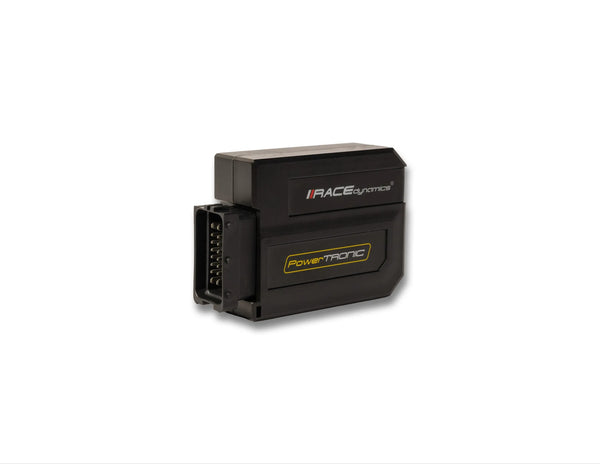
A piggyback ECU sits between the factory sensors and the stock ECU. It reads the crank position, throttle position, and manifold pressure signals, modifies them based on its own fuel and ignition maps, and sends the altered values to the stock ECU. The factory ECU believes conditions are slightly different and delivers the fuel or spark the piggyback has commanded. PowerTRONIC is the most widely supported piggyback option in India, with bike-specific harnesses that plug into the injector, TPS, and crank sensor connectors.
Because the piggyback has its own processor and map storage, it can add or subtract fuel and adjust ignition advance at every RPM and throttle position. Most units also let you switch between two maps on the fly, which is useful if you want a fuel-economy map for the highway and a power map for the hills. The stock ECU remains completely untouched, so the piggyback can be unplugged and the bike returned to stock in under thirty minutes.
Pros of a piggyback ECU
- Full reversibility. Remove the harness and the bike is factory again.
- Adjustable by the owner using a laptop or smartphone app. You can tweak fuel and ignition per cell.
- Map switching on the move. Useful for varying fuel quality across Indian states.
- No ECU disassembly. No warranty flags from a modified ECU checksum.
Cons of a piggyback ECU
- Cannot raise the rev limit or disable error codes. Those live inside the stock ECU.
- Installation is more involved than a plug-and-play module. You are tapping into multiple sensors.
- The stock ECU's closed-loop correction can still fight small fuel changes at part throttle unless the piggyback has a strategy to work around it.
- Cost is higher than a simple fuel module, and tuning skill matters. A bad map is worse than stock.
The plug-and-play fuel module approach
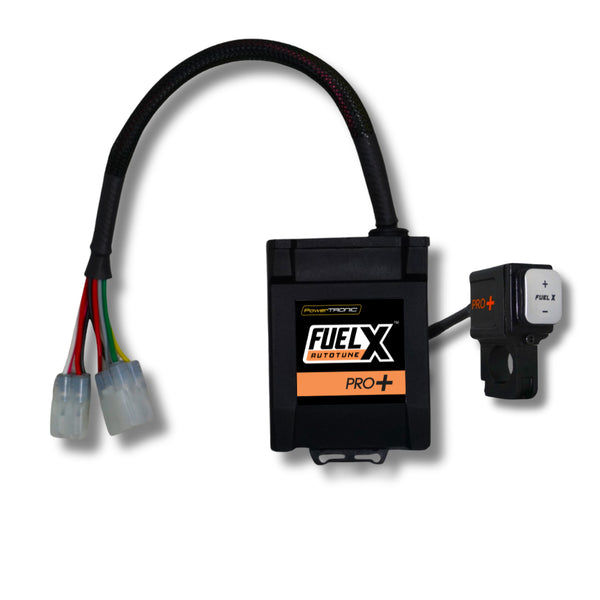
A plug-and-play fuel module, like the FuelX range, connects inline with the O2 sensor and sometimes the injector. It reads the stock O2 sensor signal and modifies the feedback voltage so the ECU adds a predetermined amount of fuel in the closed-loop region. Some units also have an injector intercept to add fuel at wide-open throttle where the O2 sensor is ignored. The installation is typically two connectors and a ground wire, done in under ten minutes with no tools beyond what is under the seat.
This method does not touch ignition timing, rev limits, or throttle maps. It corrects the air-fuel ratio only, which is exactly what a stock bike with a slip-on exhaust and a better-breathing performance air filter needs. It is the most popular first step for riders who want to clean up the lean factory tune without committing to a full ECU solution.
Pros of a plug-and-play fuel module
- Installation is genuinely plug-and-play. No wire splicing, no laptop.
- Removes the part-throttle leanness and surging that comes with a freer-flowing exhaust.
- Completely reversible in minutes. Unplug it and the bike is stock.
- Lower cost than a piggyback or a custom remap. The value proposition is strong for a stage 1 setup.
Cons of a plug-and-play fuel module
- No ignition control. You leave power on the table if the engine wants more advance.
- No rev limit adjustment. The bike will still hit the factory limiter.
- Limited to correcting the air-fuel ratio. If you go beyond a slip-on and filter, the module may not have enough range.
- Some advanced modules offer multiple maps, but the adjustment is still AFR-only.
When each method makes sense on Indian roads
The right choice depends on your current modifications and your future plans. A rider who fits a slip-on from Red Rooster or Powerage and a BMC or NGage filter will see a real improvement from a plug-and-play fuel module. The bike runs cooler, throttle pickup cleans up, and the installation does not require a single tool beyond the seat key. If you plan to stop there, a fuel module is the most sensible spend.
A piggyback ECU becomes the right answer when you add a full system exhaust with decat headers or when you want to tune for a specific riding condition, like high-altitude passes in the Himalayas where air density changes dramatically. The ability to switch maps means you can have a power map for the plains and a richer, safer map for sustained high-load climbing. PowerTRONIC's support for Indian motorcycles covers most of the popular platforms, and the harness quality has reached a point where installation is genuinely plug-and-play on newer kits.
A remap is the deep end. It is the correct choice for a built engine, a big-bore kit, or a race bike where every degree of ignition advance matters. It also makes sense for riders who want the cleanest possible installation with no extra boxes on the bike. The trade-off is permanence. If you sell the bike, the new owner gets the tune unless you flash it back. If the dealer reflashes the ECU during a service, your remap is gone.
A plug-and-play fuel module fixes the lean spot. A piggyback ECU lets you build the whole fuel and ignition curve. A remap rewrites the rulebook. Pick the one that matches how far you are willing to go, not the one that sounds most impressive in a spec sheet.
| Factor | Remap / Flash | Piggyback ECU | Plug-and-Play Fuel Module |
|---|---|---|---|
| What it adjusts | Fuel, ignition, rev limit, throttle maps, DTCs | Fuel and ignition | Air-fuel ratio only |
| Installation | ECU removal and bench flash | Harness plugged into sensors | Inline with O2 sensor, under 10 minutes |
| Reversibility | Days and a re-flash | Unplug in 20-30 minutes | Unplug in 5 minutes |
| Warranty risk | Detectable checksum change | Minimal if removed before service | Minimal if removed before service |
| Best for | Full exhaust, built engine, race use | Full exhaust, varying fuel, map switching | Slip-on exhaust and filter, stage 1 |
| Owner adjustability | None without re-flash | Laptop or app tuning | Limited to preset maps if available |
| Relevant brands at Rawtorque | Custom tuning services | PowerTRONIC | FuelX |
How to choose the right tuning method for your motorcycle
- List your current modifications. If the bike has only a slip-on exhaust and a performance air filter, a plug-and-play fuel module like FuelX will correct the lean condition and you will feel the difference immediately. Do not over-buy capability you will not use.
- Decide your modification ceiling. If a full system exhaust is in your future, skip the fuel module and go straight to a piggyback ECU. You will spend less in the long run than buying a fuel module now and a piggyback later.
- Consider where you ride. Riders who cross the Himalayas or ride in extreme heat need the map-switching ability of a piggyback. A single fixed map, whether from a remap or a fuel module, is a compromise across 3000 metres of altitude change.
- Check your warranty situation. A bike still under factory or extended warranty is better served by a removable solution. A piggyback ECU or fuel module can be removed before a service visit. A remap leaves a footprint.
- Assess your own tuning skill. A piggyback ECU that lets you adjust fuel and ignition cells is powerful but requires understanding what lean and rich feel like. If you do not want to learn, a fuel module with preset maps or a professionally done remap is the safer path.
- Talk to someone who has done it. The Rawtorque team offers fitment guidance and can help you match the right ECU and fuel controllers to your specific bike and exhaust setup. Reach out with your bike model and current parts list.
Frequently asked questions
Does a plug-and-play fuel module void my motorcycle warranty?
It is a removable device that does not alter the ECU. If you unplug it before a service, there is no trace left on the bike. The risk is lower than a remap, but you should still understand your manufacturer's specific warranty terms.
Can I use a piggyback ECU with a completely stock bike?
You can, but the gains are small. The stock ECU already handles a stock engine and exhaust well. A piggyback ECU starts to earn its cost when you add a performance exhaust and intake that shift the volumetric efficiency away from what the factory map expects.
Which tuning method gives the most horsepower?
A custom remap on a dyno can extract the most because it adjusts ignition timing and can run the engine closer to the knock threshold. A piggyback ECU with proper tuning gets very close. A fuel module alone will not match either because it leaves ignition timing stock.
Is a remap permanent?
No, but it is not quickly reversible. You need to send the ECU back to the tuner to have the stock file reflashed. Some tuners provide a handheld flasher that lets you switch between the stock and tuned map, but this is less common on motorcycle ECUs than on cars.
Will a fuel module fix the low-speed jerkiness on my fuel-injected bike?
In most cases, yes. The factory lean condition at small throttle openings is the primary cause of that jerkiness. A fuel module that enriches the closed-loop area will smooth out the throttle response noticeably, especially on single-cylinder and parallel-twin platforms.
Can I install a piggyback ECU myself?
If you can remove your fuel tank and follow a wiring diagram, yes. PowerTRONIC kits come with bike-specific harnesses and colour-coded connectors. The work is methodical, not complex. If you are not comfortable accessing the injector and TPS connectors, a shop can install it in under an hour.
Explore the range

Featured in this guide