Performance Guides
Honda CB350 Performance Upgrades (2026): What Works, What Does Not Exist, and What to Avoid
A straight guide to modifying the Honda CB350, CB350C, H'ness and CB350RS. The upgrades that genuinely work, the parts that do not exist despite what search results suggest, and two expensive mistakes owners keep making.

Most CB350 upgrade advice online is written by people who have not measured anything. This guide is the opposite. It comes out of specifying a full build for a customer running a CB350C at 2,400 metres in Mexico City, where every wrong assumption would have cost him money he could not recover.
Some of what follows will disappoint you. That is rather the point.
What you are actually working with
Every CB350 variant shares one engine, the NC58E:
- 348.36 cc, air-cooled, single cylinder, SOHC two valve
- Bore 70.0 mm, stroke 90.5 mm, compression 9.5:1
- 21 PS at 5,500 rpm, 30 Nm at 3,000 rpm
- Gearing 14T front, 35T rear, 520 chain, 104 links
- Brakes 310 mm front disc with a two-piston caliper, 240 mm rear disc with a single piston
That stroke-to-bore ratio of 1.29 is the single most important number here. This is a deliberately long-stroke engine that makes peak torque at 3,000 rpm and stops pulling shortly after 5,500. Every sensible decision follows from respecting that rather than fighting it.
The upgrades that genuinely work
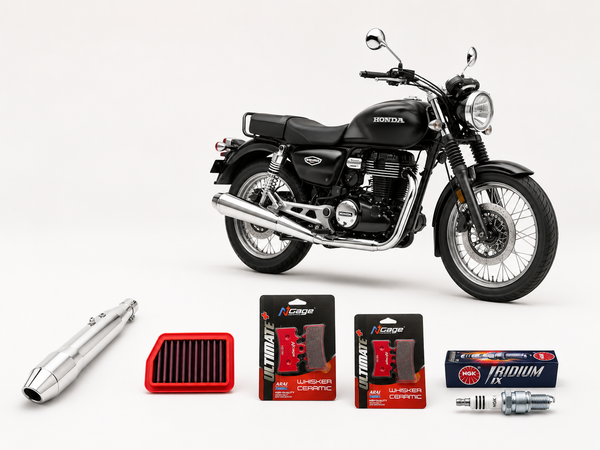
A slip-on exhaust, not a full system
A slip-on retains the factory header, which matters more than it sounds. A full system with a larger primary pipe moves the tuned point up the rev range, trading away exactly the low-end torque that makes this engine pleasant. Realistic gain is one to two PS, plus considerably better throttle response and a note worth having.
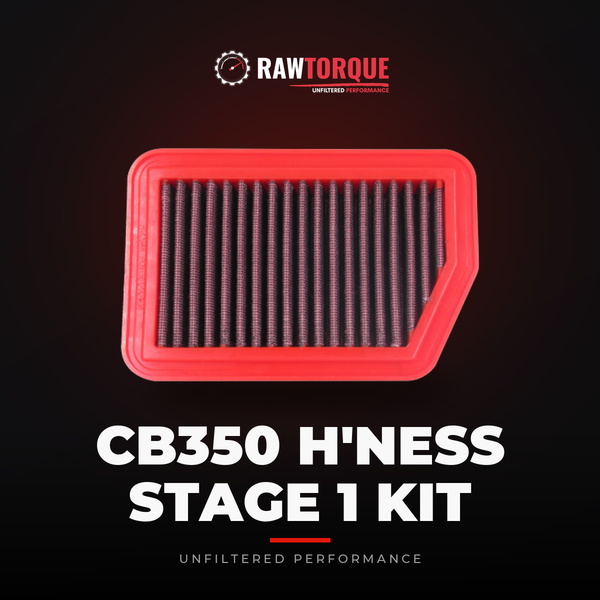
A high-flow air filter
A washable cotton gauze element drops into the standard airbox with nothing modified. Modest on its own, but it is what allows the exhaust and any fuelling module to do their work.
An iridium spark plug
The correct plug is a CPR8EAIX-9, at 0.9 mm gap. The fine-wire electrode needs less voltage to fire and gives a more consistent burn. Inexpensive, and there is no reason to run anything else on a modified engine.
A piggyback ECU or fuelling module
Once the filter and exhaust are on, Honda's factory mixture target is no longer the right one. A fuel-only module such as a FuelX corrects the mixture and adapts continuously. A full piggyback ECU adds ignition timing control, which is the more powerful lever and matters enormously if you ride at altitude.
Gearing, the most underrated change of all
Almost nobody mentions this, and it is the cheapest meaningful improvement available. Going from the standard 14T front sprocket to 13T gives roughly 7.7% more torque at the wheel. Owners report pulling away in second easily, holding third through city speeds without lugging, and fifth finally becoming usable from around 60 km/h.
The cost is top end. Expect it to drop by 10 to 15 km/h, with the engine feeling strained above 100 to 105 km/h. If you ride mostly in town or in hills, that is a trade worth making. If you cover long highway distances, it is not.
Better brake pads
Ceramic pads bite well from cold, which is what city traffic actually asks for, and they are quieter and kinder to your discs than sintered. Sintered copes better with sustained heat, so it suits riders doing long mountain descents. For most riders on most roads, ceramic is the better choice.
What does not exist, whatever search results suggest
There is no big bore kit, no performance camshaft, no high-compression piston and no intake or snorkel kit commercially available for this engine. Not in India, and not in Japan, where the GB350 aftermarket is otherwise mature and has had five years to produce one.
That absence is informative rather than an oversight. Consider the intake question. At peak power this engine asks for roughly 29 cubic feet of air per minute, which is less than a domestic bathroom extractor fan moves. What limits the top end is the two-valve cylinder head and the camshaft, not the airbox feeding it. Widening a pipe upstream of a restriction that lies downstream changes nothing, which is why nobody sells one.
Similarly on camshafts. An engine that stops pulling at 5,500 rpm gains nothing from a high-lift cam, and would lose the low-end torque you actually use.
Two expensive mistakes owners keep making
Buying 1970s CB350 pistons
Search for a CB350 big bore piston and you will find Wiseco kits in 65 mm and 67.47 mm. Those are for the 1970s CB350 twin, a completely unrelated engine. They will not fit any modern CB350. This catches people out regularly and the parts are not cheap.
The improvised 13T front sprocket
Because no mainstream manufacturer offers a 13T front sprocket for this bike, a workaround circulates using a Suzuki Gixxer 250 sprocket held in place with circlips and a washer. It does not have the OEM retaining screw holes.
The rider who documented it most thoroughly reported loud clatter from the front sprocket area under revs and gearshifts that became heavy and imprecise. His own mechanic warned him during installation. He later replaced it with a properly made part and the symptoms disappeared entirely.
A countershaft sprocket carries significant torque. If it works loose it can damage the engine case or lock the rear wheel. Have one made correctly, or leave the gearing alone.
Which CB350 do you actually have?
Honda sells the CB350, CB350C, CB350C Special Edition, H'ness CB350 and CB350RS. Engine, airbox, brakes and drivetrain are common across all of them, so filters, plugs, pads and sprockets interchange freely.
The exhaust is the exception. The CB350 and CB350C use a long level silencer. The H'ness and CB350RS both use upswept units and take different parts. This is the single most common fitment error on this platform, and it is not recoverable once the box is opened.
If you are unsure which variant you own, a photograph of the right side of the motorcycle settles it. We are happy to give fitment guidance before you order.
A package for each variant
We assemble the same five upgrades for each bike, changing only the exhaust. Filter, plug and both sets of brake pads are identical across all three.

CB350, CB350C and CB350 Special Edition, with the Red Rooster Pegasus Max.

H'ness CB350, with the Red Rooster Pegasus.

CB350RS, with the Red Rooster Pegasus RS in black.
Riding at altitude
If you ride above about 2,000 metres, the standard derate is roughly 3% of power per 1,000 feet. At 2,400 metres you are down about 24%, so 21 PS behaves like 16 PS.
The important detail is what kind of loss that is. Modern CB350s have barometric and oxygen sensor correction, so the mixture is already being adjusted. The engine is not running badly. It is simply receiving less air per cycle, and no fuel map alone recovers that. Anyone selling you a remap for altitude on an otherwise standard bike is selling you very little.
Two things genuinely help. Shorter gearing, which directly counteracts what altitude took from your acceleration. And ignition timing, because lower cylinder pressure at altitude gives a much wider safe advance window than a sea level bike has. That is a job for a piggyback ECU rather than a fuel-only module.
If you want to go further
Raising compression is the one deeper modification worth considering, and it is particularly suited to riders at altitude who have more knock margin to work with than they realise.
The arithmetic, from Honda's published figures: with 348.3 cc swept and 9.5:1, total clearance volume is approximately 41.0 cc. Reaching 10.5:1 means removing about 4.3 cc; 11.0:1 means about 6.2 cc.
Skimming the cylinder head removes roughly 3 cc per millimetre on this bore, so 11:1 would need about 2 mm off. That is far too much. You lose squish clearance millimetre for millimetre, the fixed-length cam chain retards your cam timing, and valve-to-piston clearance closes. A skim realistically reaches about 10.0:1 before those problems start compounding.
Beyond that you need a custom piston, which keeps deck height, squish band and cam timing exactly as Honda set them and puts the compression change into the crown where you control it deliberately. This is engine building, not parts fitting, and it needs measuring, claying and dyno verification by someone competent.
Common questions
How much power will a Stage 1 kit add to a CB350?
Realistically one to two PS from filter and exhaust, plus a meaningful improvement in throttle response and mid-range feel. Anyone promising five PS from bolt-ons on this engine is guessing.
Do I need an ECU or fuel module after fitting an exhaust?
Not strictly. A slip-on with the standard header works without one. A module lets you realise more of the gain and is worth it if you are also changing the filter.
Is there a big bore kit for the CB350?
No. Reaching 400 cc would need a 75 mm bore, removing 2.5 mm of wall per side on an air-cooled barrel. That compromises cylinder wall and cooling fin section on an engine with no radiator.
Will a CB350RS exhaust fit a CB350C?
No. The silencers differ between variants. Check before ordering.
What spark plug does the CB350 use?
CPR8EA-9 as standard, and CPR8EAIX-9 for the iridium equivalent, at 0.9 mm gap.
The short version
Fit a slip-on exhaust, a high-flow filter and an iridium plug. Add a fuelling or ignition module if you want to realise the full gain. Change your gearing if you ride in town or in hills. Fit ceramic pads because they are cheap and genuinely better.
Do not chase displacement or camshafts on this engine. They do not exist, and if they did, they would make your motorcycle worse at the things it is good at.
If you are unsure about anything here, message us with your model and how you ride. We would rather tell you not to buy something than sell you the wrong part.
Explore the range


Featured in this guide