Performance Guides
Why Your Car AC Smells in India (2026): The Real Cause and How to Fix It for Good
The musty smell comes from bacteria on your AC evaporator, not the vents. What causes it, four fixes from a Rs 400 cabin filter up, and how to stop it returning.

The smell is not coming out of your vents. It is coming off a layer of bacteria and mould growing on the evaporator core behind your dashboard, and no air freshener will ever touch it. That is why the smell comes back a week after you hang a new perfume from the mirror. You are perfuming the problem rather than removing it.
If your car breathes out a damp, sour, gym-bag smell for the first thirty seconds after you switch on the AC, and it then fades, you have the textbook version of this. The trade calls it dirty sock syndrome, and in a humid country it is close to universal. The good news is that it is one of the cheapest faults on a car to fix properly, usually under ₹2,500 in parts, and it stays fixed if you change one habit.
This guide covers where the smell actually comes from, why Indian conditions make it so much worse, the four causes ranked by how common they are, what each fix costs, and the two minute habit that prevents it returning.
Where the smell actually comes from
Your air conditioner does two jobs. It cools the air and it dries it. Both happen at the evaporator, a finned aluminium core buried in the housing behind your dashboard.
Refrigerant expands inside that core and drops its surface temperature to roughly 0 to 5 degrees. Warm cabin air is drawn across the cold fins, and the moisture in that air condenses on them exactly the way water beads on a cold glass. The condensate is meant to run down the fins, gather in the housing and drain out through a rubber tube onto the road. That puddle under a car that has been running its AC is the system working correctly.
Now consider what that core actually is. It is dark, it has an enormous surface area, it is permanently damp, and it sits at a temperature that suits bacteria and mould very well. Every particle of dust, pollen and organic debris that gets past the cabin filter lands on those wet fins and stays there. Within one humid season you have a biofilm.
When you switch the AC on, the blower pushes the cabin's entire air supply across that colony before it reaches your face. The first thirty seconds are the worst because that is the concentrated slug of air which has been standing in the ducts overnight. Then it dilutes and you stop noticing, which is precisely why most owners live with it for years.
Why it is worse in India
Four things stack up against Indian cars, and coastal states such as Kerala get all four at once.
- Humidity. The more moisture in the air, the more condensate forms on the evaporator, and the longer the core stays wet between drives. A monsoon coastline is close to the worst case.
- Short trips. A twenty minute commute never gives the core a chance to dry. The car is parked wet, every day.
- Recirculation. Most drivers here run recirculate permanently because the outside air is hot and dirty. That keeps the same damp air cycling through the same wet box instead of flushing it.
- Organic debris. Parking under trees drops leaf matter and pollen into the cowl intake at the base of the windscreen, which is the doorway to the whole system.
This is also seasonal. Complaints spike during and just after the monsoon, which is when the core is wettest and warmest for longest. If your car has started smelling in the last few weeks, that is not a coincidence.
The four causes, ranked
1. A saturated cabin filter
The cabin filter sits in the air path, usually behind the glovebox, and catches dust, pollen and leaf matter before it reaches the evaporator. Once it is loaded it stops being a filter and starts being a damp sponge with its own smell, and it chokes airflow at the same time. If your AC has also felt weaker lately, this is the first thing to check. Most manufacturers suggest replacement every 10,000 to 15,000 km or annually, and Indian dust and humidity argue for the shorter end of that.
2. A blocked evaporator drain
If the drain tube is blocked by silt, leaf debris or an insect nest, condensate has nowhere to go. It pools in the housing and the evaporator effectively sits in a small stagnant pond. This is the version that produces a genuinely foul rather than merely musty smell.
Two symptoms give it away. Your car never leaves a puddle after running the AC on a humid day, and the passenger footwell carpet feels damp. If you have wet carpet, deal with the drain before you spend anything on cleaners, because you are treating a swamp.
3. Biofilm on the evaporator itself
This is the actual source in most cars, and it is the one people skip because the core is not something you can reach. It has to be treated chemically, in place. A disinfectant designed for the job is introduced into the evaporator housing so it wets the fins, kills what is growing there, and drains away with the condensate.
4. Debris in the cowl and plenum
The intake grille at the base of the windscreen collects leaves, and they rot where they land. Lift the wiper cowl area and clear it out. This costs nothing and it is the cause people most often overlook, particularly on cars parked under trees.
How to fix it, in order
Work down this list rather than jumping to the last step. Treating the evaporator while the filter is saturated and the drain is blocked will buy you a few weeks at most.
| Step | What it addresses | Typical cost |
|---|---|---|
| Clear the cowl and check the drain | Rotting debris and standing water | Free |
| Replace the cabin filter | The damp sponge in the air path | ₹400 to ₹2,500 |
| A/C System Cleaner 250 ml | The biofilm on the evaporator, the actual source | ₹1,400 |
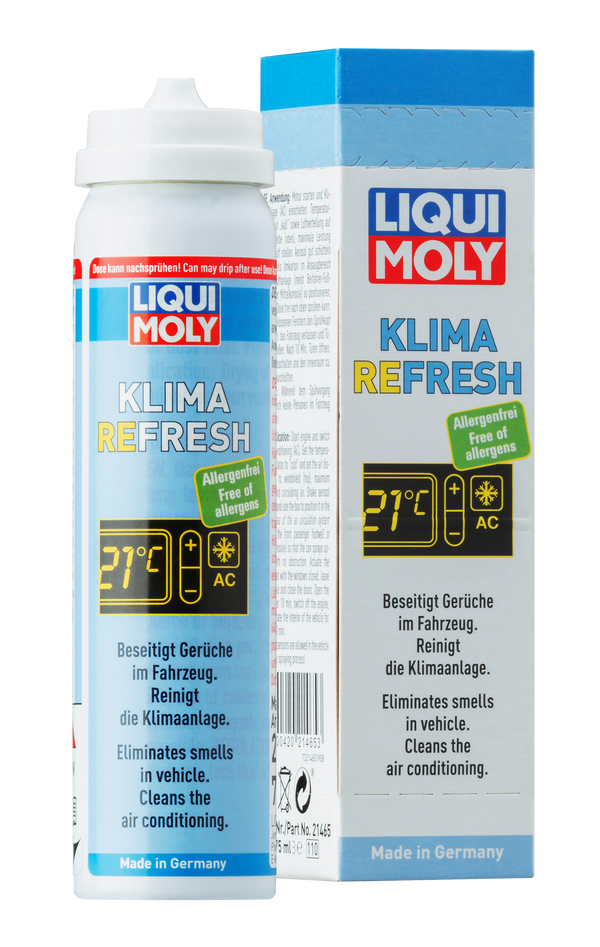
| Klima Refresh 75 ml | Residual odour in the cabin, ducts and trim | ₹990 |
| Workshop evaporator removal | Severe or repeat cases only | Several thousand, the dash usually comes out |
The two chemical steps are a pair rather than alternatives, and the order matters. The A/C System Cleaner is the one that kills the colony on the core. Klima Refresh is an automatic treatment you trigger inside the closed cabin with the blower running on recirculate, so it carries through the ducts, the headliner and the seat fabric that have absorbed the smell over months. Cleaner first, refresh second. Using the refresh on its own is the aerosol equivalent of an air freshener with a better vocabulary.

Follow the instructions on each pack for dwell time and ventilation, and air the car out properly before you drive it.
The habit that stops it coming back
This is the part worth more than anything you can buy.
About two minutes before you reach your destination, switch the AC compressor off but leave the blower running. Warm ambient air then passes over the evaporator and dries it before you park. A dry core does not grow anything, and you have removed the condition the whole problem depends on.
Two smaller habits help. Give the system fresh air rather than recirculate for part of every drive so the box gets flushed. And on a dry day, run the blower with the windows open for a minute before you set off.
Do the cleaning once and adopt the two minute habit, and most cars simply stop smelling. Skip the habit and you will be buying cleaner again next monsoon.
What not to bother with
- Hanging air fresheners and vent clips. They add a second smell on top of the first. Within a fortnight your car smells of damp and jasmine rather than just damp.
- Spraying deodoriser into the vents. The vents are the exit, not the source. You are treating the far end of the pipe.
- A regas. Refrigerant level has nothing to do with odour. If a workshop proposes a regas for a smell complaint, ask them what they think is growing on the evaporator.
- Ozone treatment as a first move. It can knock back odour, but it does not remove the biofilm, so the smell returns. It is a last resort after the core has been cleaned, not instead of it.
Is a smelly car AC actually harmful?
For most people it is unpleasant rather than dangerous. It does matter more if someone in the car has asthma, an allergy or a compromised immune system, because what you are smelling is bacterial and fungal growth being blown into an enclosed space you sit in daily. Treat it as a hygiene item on the service list rather than a cosmetic one, in the same category as the cabin filter it is connected to.
Why buy your AC care from Rawtorque
- Genuine Liqui Moly, made in Germany, sold by a registered Indian business rather than a marketplace reseller.
- The cleaner and the refresh are stocked as a pair, because treating the evaporator and deodorising the cabin are two different jobs.
- Partial COD on serviceable pincodes: a small advance online to confirm, balance on delivery.
- Aerosols ship by surface, so shipping is quoted honestly upfront rather than failing at the hub.
- Guidance from our team if you are not sure which step your car actually needs.
Frequently asked questions
Why does my car AC smell bad when I turn it on?
The smell comes from bacteria and mould growing on the evaporator core behind your dashboard. The evaporator is permanently damp because it condenses moisture out of the air as it cools it, and that damp, dark, dusty surface is ideal for microbial growth. When the blower starts, it pushes air across that growth before it reaches you.
Why does my car AC only smell for the first few minutes?
The air standing in the ducts overnight is the most concentrated. Once the blower flushes it out, fresh air dilutes the odour and your nose adapts to what remains. The source has not gone anywhere, which is why it is back the next morning.
How do I get rid of the smell from my car AC?
Work in order. Clear debris from the cowl at the base of the windscreen, confirm the evaporator drain is not blocked, replace the cabin filter, then treat the evaporator with an AC system cleaner and deodorise the cabin with an odour eliminator. Skipping to the last step alone gives short lived results.
Does changing the cabin filter stop the AC smell?
It helps and it is always worth doing, but on its own it usually is not enough. A saturated filter carries its own smell and restricts airflow, yet the main colony is on the evaporator behind it. Change the filter and treat the core in the same session.
Why is my car's passenger footwell wet?
Almost always a blocked evaporator drain. Condensate that should drain onto the road backs up in the housing and overflows into the cabin. Clear the drain before spending anything on cleaners, because a blocked drain will regrow the problem within weeks.
Can I just use an air freshener instead?
No. An air freshener adds a fragrance on top of the odour without removing its source, so the car ends up smelling of both. It is the single most common wasted spend on this problem.
How often should I clean my car AC system?
Once a year suits most Indian cars, ideally just after the monsoon when the evaporator has been wettest for longest. Cars parked outdoors, driven on short trips, or run permanently on recirculate benefit from twice yearly.
How much does it cost to fix a smelly car AC in India?
Done yourself, usually under ₹2,500. A cabin filter runs roughly ₹400 to ₹2,500 depending on the car, an AC system cleaner is ₹1,400 and an odour eliminator is ₹990. Clearing the cowl and checking the drain costs nothing. Only severe cases need the dashboard removed for physical evaporator access, which runs into several thousand rupees in labour.
Will running the fan without AC dry the evaporator?
Yes, and this is the best preventive habit there is. Switch the compressor off around two minutes before you park and leave the blower running so ambient air dries the core. A dry evaporator does not support the growth that causes the smell.
Does an AC regas fix the smell?
No. Refrigerant charge affects cooling performance, not odour. A smell complaint answered with a regas quote is a sign to ask more questions.
Written by Lijo Mathew Jacob, founder of Rawtorque. Rawtorque supplies genuine Liqui Moly car care, performance and maintenance products to owners across India. Last updated 20 August 2026.
Explore the range
Featured in this guide