Performance Guides
E20 Ethanol Fuel in India: What It Does to Your Engine and Which Parts Fail First (2026)
E20 became the only petrol sold in India on 1 April 2026. What 20 percent ethanol actually does inside your fuel tank, lines, carburettor and injectors, which components fail first, what the government's testing says versus its critics, and which manufacturers offer a retrofit kit.

E20 petrol, blended with up to 20 percent ethanol, became the only fuel sold at any petrol pump in India from 1 April 2026, with a minimum Research Octane Number of 95. There is no E10 or E5 option left anywhere in the country. For vehicles built from April 2023 onward, this is a non-event, they are certified E20-compliant from the factory. For anything older, especially carbureted motorcycles, E20 can lean out the air-fuel ratio, pull moisture into the fuel system, swell and crack rubber components, and leave deposits in fuel filters and injectors.
This guide is the diagnosis: how to check whether your own vehicle is compliant, exactly what changes inside your fuel system, which parts fail first and what that feels like from the saddle or the driver's seat, what the government's own testing says versus what critics have raised, which manufacturers actually sell a retrofit kit, and whether you can still buy petrol with no ethanol in it at all. If you already know the damage and want the fix, read our companion guide, how to protect your engine and recover throttle response and mileage on E20.
What is E20 fuel, and how did India get here?
E20 is petrol blended with up to 20 percent ethanol, and it has been mandatory at every pump nationwide since 1 April 2026. The rollout is part of India's ethanol-blending programme, which reached the 20 percent target years ahead of its original 2030 goal. Two dates matter for vehicle owners. First, April 2023: every new petrol vehicle sold in India since then, car or two-wheeler, must be certified E20-compliant by its manufacturer. Second, 1 April 2026: the fuel itself changed nationwide, so even a vehicle that was never designed for E20 is now running on it, whether it is ready or not.
Is your vehicle E20 compliant? How to check
The single dividing line is April 2023. Every petrol vehicle sold new in India from that month onward is certified E20-compliant by its manufacturer. Anything older was not designed around a 20 percent blend, and the risk rises the further back you go and the more rubber and carburetor content the fuel system has.
As a rule of thumb:
| Your vehicle | E20 status | Risk level |
|---|---|---|
| Made April 2023 onward | Certified E20-compliant by the manufacturer | Lowest |
| BS6, roughly 2020 to March 2023 | Materials generally tolerate E20, but not certified for it | Low to moderate |
| BS4, roughly 2017 to 2020 | Not designed for E20, mostly fuel injected | Moderate |
| BS3 and older, especially carbureted | Not designed for E20, highest rubber and carburetor content | Highest |
Royal Enfield's own retrofit kit supports this reading: it is sold for BS3 and BS4 carbureted bikes and is explicitly not needed on BS6 models.
Three ways to confirm your specific vehicle. Check the owner's manual, which on post-2023 vehicles states E20 compatibility directly. Check the sticker inside the fuel filler flap or on the tank, where many manufacturers now print the maximum blend. Or call your manufacturer's customer care with your VIN or chassis number, which is the definitive answer for a vehicle built near the 2023 cutoff.
One thing compliance does not mean. An E20-compliant badge means the materials in the fuel system tolerate the blend. It does not mean your mileage is unaffected, and it does not make the fuel's moisture absorption go away. Compliant vehicles are still reporting gasket seepage, so a periodic fuel-system inspection is worth the two minutes whatever your build date.
What does ethanol actually do inside your fuel system?
Two properties of ethanol explain almost everything that follows. It is hygroscopic, meaning it actively draws moisture out of the air, and it is a stronger solvent than pure petrol.
- Moisture and phase separation: as ethanol absorbs water from humid air (especially in a tank that sits for long periods, or one with a poor seal), it can eventually hold more water than it can stay blended with. Past that point, the water and ethanol separate out from the petrol and settle at the bottom of the tank, a process called phase separation. This is what causes sudden hard starting, stalling, and rust in the bottom of older steel tanks, corrosion is really a downstream symptom of moisture absorption, not a separate problem.
- Deposits and swelling: ethanol's solvent action loosens old varnish and sludge sitting in tanks and lines that pure petrol would have left alone, and carries it toward the filter and injectors. At the same time, rubber and some plastics not rated for ethanol swell on contact with it, then harden and crack once the ethanol evaporates off, a cycle that repeats with every fill-up.
- A leaner mixture: ethanol carries its own oxygen, so an engine tuned purely for petrol can end up running leaner than intended on E20. Carburetors and older, narrow-range fuel-injection systems have no way to compensate on their own.
- Lower energy content: ethanol carries less energy per litre than petrol, so even a perfectly tuned engine burns somewhat more fuel per kilometre on E20 than on pure petrol.

Which parts wear out first, and what does it feel like?
The damage is not random, it follows the path the fuel actually takes through the vehicle.
| Component | What ethanol does to it | What you will notice |
|---|---|---|
| Fuel tank | Draws in moisture, risk of phase separation and rust in older steel tanks | Water in the tank, sudden hard starting after standing |
| Fuel lines, hoses, O-rings, seals, gaskets | Swell on contact with ethanol, then harden and crack over repeated cycles | Fuel smell, visible cracking, leaks at joints |
| Carburetor float | Absorbs ethanol and can swell or sink if not ethanol-rated | Flooding, rough idle, hard starting |
| Fuel pump and diaphragm | Wears faster if the internals are not ethanol-rated | Weak fuel delivery, intermittent stalling |
| Fuel filter | Clogs as ethanol loosens old varnish and sludge further up the line | Reduced power, hesitation, especially on long trips |
| Fuel injectors | Deposits build on the injector tip over time | Rough idle, occasional misfires |
| Air-fuel ratio | Can run leaner than the engine was tuned for | Hesitation, flat spots, harder cold starts |
None of these symptoms are dramatic in isolation, which is why they often get blamed on old fuel, a weak battery, or general wear. If your vehicle is pre-2023 and has not had its fuel-system rubber inspected since the E20 switch, this list is a reasonable place to start.
Why do two-wheelers feel it before cars do?
Two-wheeler fuel systems pack more rubber and polymer per unit of engine displacement than a car's does, smaller tanks, shorter lines, and in older bikes, an actual carburetor rather than sealed fuel injection. Carbureted 350cc Royal Enfields, older Bajaj, Hero and Honda commuters, and similar pre-2023 bikes are the vehicles most likely to show hesitation, flooding or hard starting first. Fuel-injected bikes fare better because a closed-loop system can partly self-correct, but only within a limited range, which is exactly the range an autotune module extends.

Is E20 fuel actually safe? What the government says, and what critics say
Both sides have a real point, and vehicle owners are better served knowing both. The Ministry of Petroleum and Natural Gas, citing testing by ARAI, the Indian Institute of Petroleum and Indian Oil across 100,000 km of running, states there is no evidence of engine damage from E20 and describes the mileage impact as marginal: 1 to 2 percent for vehicles originally designed for E10 and recalibrated for E20, and 3 to 6 percent for other vehicles. The ministry also says any rubber gasket that does need replacing is a low-cost job manageable at a regular service, typically after 20,000 to 30,000 km.
At the same time, real-world reports from owners on enthusiast forums often describe steeper mileage drops, sometimes into double digits, though these are anecdotal rather than lab-tested figures and vary a great deal with vehicle condition and driving style. Separately, a right-to-information request for the full ARAI test report was turned down as confidential, which has drawn criticism over transparency. Independent environmental analyses, including reporting by Down To Earth, have also raised concerns that E20 may increase nitrogen oxide and acetaldehyde emissions and raises fuel vapour pressure, arguing Indian test protocols do not fully capture peak summer conditions the way some other countries' do. There is no official retrofit programme for the broader older vehicle fleet, so beyond the manufacturer kits below, any adaptation cost falls on the owner.
For the record, our own position on how this was introduced, and on the unverifiable purity of the ethanol reaching Indian pumps, is set out in the companion guide.
Does your manufacturer offer an E20 retrofit kit?
Royal Enfield is the only manufacturer with a real, purchasable kit as of mid-2026. It covers BS3 and BS4 carbureted 350cc UCE models, the Classic 350, Bullet 350 and Thunderbird 350, and comprises ethanol-resistant O-rings, tubes and seals. It costs around Rs 1,700 for BS4 bikes and roughly Rs 3,000 to 4,000 for BS3 bikes, and it is sold and fitted only through authorised Royal Enfield dealerships and service centres, several of which report patchy stock, so it is worth calling ahead. BS6 Royal Enfields do not need it, they are already E20-compliant. Two important gaps: the kit does not cover the Interceptor, Continental GT or Super Meteor 650 twins, or the 500cc UCE bikes, and it only replaces rubber, it does not correct the air-fuel ratio.
Maruti Suzuki has been reported to be planning a similar kit for cars up to 10 to 15 years old, priced in the region of Rs 4,000 to 6,000, covering ethanol-resistant fuel lines, seals and gaskets, but as of this writing it remains unconfirmed and not yet on sale. Hero, Honda, Bajaj and TVS have not announced retrofit kits for their older two-wheelers, their E20 strategy so far is limited to new models built from April 2023 onward. Generic "universal" E20 conversion kits sold online outside these official channels are worth approaching with caution, there is no brand accountability behind the claim.
Can you still buy petrol without ethanol?
Yes, but only as premium 100-octane fuel, and only at some pumps. While E10 and E5 have disappeared from Indian retail entirely, three grades remain unblended: XP100 from Indian Oil, Speed 100 from Bharat Petroleum and Power 100 from Hindustan Petroleum. All three are 100 RON with zero percent ethanol, exempt from the blending mandate because they are specialised fuels carrying performance additives. Indian Oil has confirmed in a right-to-information reply that XP100 contains no ethanol.
The catch is price and availability. These grades run in the region of Rs 165 to 170 per litre, well over regular petrol, and they are stocked only at selected outlets in larger cities rather than across the network. Filling a daily commuter on 100-octane fuel is not a realistic plan for most people.
Where it does make sense is a vintage, classic or weekend machine that sits between rides. Those are exactly the vehicles most exposed to phase separation, because the damage happens while the fuel sits absorbing moisture rather than while you ride. Running an unblended tank before a long layup sidesteps that problem entirely.
For everything you actually ride daily, the practical answer is not chasing ethanol-free pumps. It is correcting the fuelling, protecting the fuel system chemically, and replacing ageing rubber, which is what the next section covers.
How do you protect your engine from E20?
A rubber-only retrofit kit fixes the seals and nothing else. Four things cover the rest, and they apply whether or not your manufacturer sells a kit:
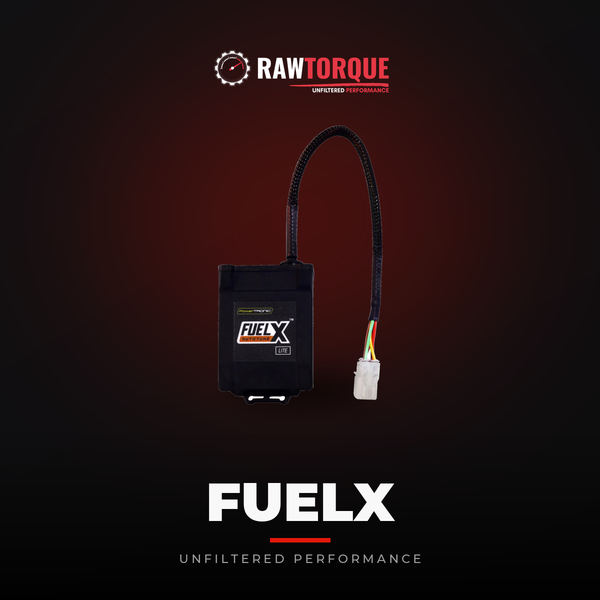
- Correct the fuelling so the engine stops running lean, with a plug-in autotune module such as FuelX or a piggyback ECU from the ECU tuning range.
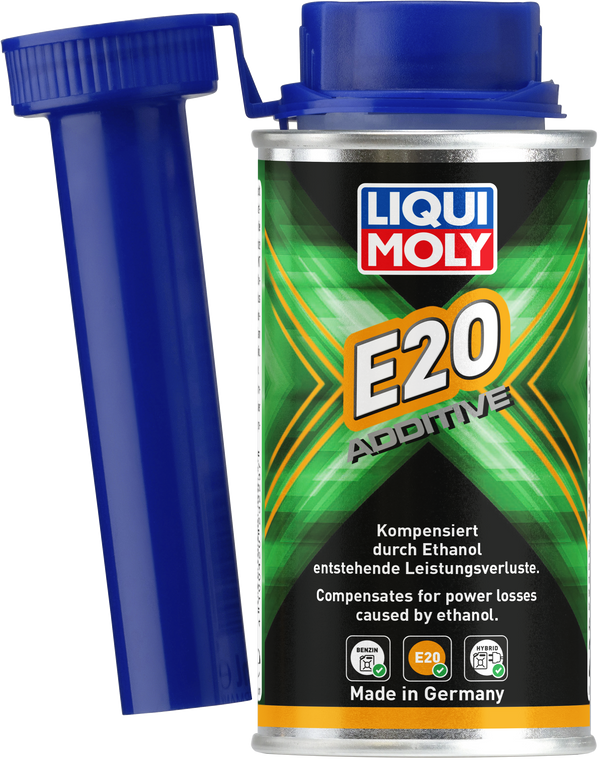
- Protect and clean the fuel system with an ethanol-specific additive, the Liqui Moly E20 Additive, backed by an occasional injector clean from the Liqui Moly range.
- Sharpen the burn with iridium spark plugs, which recover the throttle crispness a leaner blend takes away.
- Replace ageing rubber with ethanol-resistant Viton (FKM) or PTFE fuel line, the one-time mechanical fix worth doing on any pre-2023 vehicle.
The first two of those are stocked together as ready-made kits: the E20 Protection Kit for Cars, the E20 Protection Kit for Motorcycles, and the two-bottle E20 Starter Kit.
Each of those is covered step by step, with intervals and a maintenance schedule, in the companion guide: E20 Petrol in India: How to Protect Your Engine and Recover Throttle Response and Mileage.
Frequently asked questions
What is E20 fuel, and is it mandatory in India now?
E20 is petrol blended with up to 20 percent ethanol, with a minimum Research Octane Number of 95. It became mandatory at every petrol pump in India from 1 April 2026, so there is no E10 or E5 option left anywhere in the country. Vehicles made from April 2023 onward are certified E20-compliant by their manufacturer.
How do I know if my vehicle is E20 compliant?
The dividing line is April 2023. Every petrol vehicle sold new in India from that month onward is certified E20-compliant by its manufacturer. To confirm your specific vehicle, check the owner's manual, look for a blend sticker inside the fuel filler flap or on the tank, or call your manufacturer's customer care with your VIN or chassis number. As a rule of thumb, BS6 vehicles from 2020 onward generally tolerate E20 without being certified for it, BS4 vehicles were not designed for it, and BS3 and older carbureted vehicles carry the highest risk.
Is there any petrol without ethanol in India?
Yes. XP100 from Indian Oil, Speed 100 from Bharat Petroleum and Power 100 from Hindustan Petroleum are 100-octane grades with zero ethanol, exempt from the blending mandate because they are specialised additive fuels. Indian Oil confirmed via a right-to-information reply that XP100 is unblended. They cost roughly Rs 165 to 170 per litre and are sold only at selected outlets in larger cities, so they suit a vintage or weekend machine, particularly before a long layup, rather than a daily commuter.
What exactly does ethanol do to my fuel system?
Ethanol is hygroscopic, so it draws moisture from the air, which can eventually cause the water and ethanol to separate from the petrol and settle at the bottom of the tank, called phase separation. It is also a stronger solvent than petrol, which loosens old deposits and can swell, then harden and crack, rubber parts not rated for ethanol.
Which parts wear out first because of E20?
Fuel lines, O-rings, seals and gaskets swell then crack over repeated exposure. Carburetor floats can swell or sink, causing flooding. Fuel pumps and diaphragms wear faster if not ethanol-rated, and fuel filters clog as ethanol loosens old varnish and carries it downstream. Two-wheelers, with more rubber per unit of engine size, tend to show these first.
Does ethanol-blended petrol reduce mileage?
Yes, to some degree. The government's own figures put the drop at 1 to 2 percent for vehicles designed for E10 and recalibrated for E20, and 3 to 6 percent for other vehicles, based on ARAI, Indian Institute of Petroleum and Indian Oil testing. Real-world owner reports on forums often describe steeper drops, though these are anecdotal rather than controlled test data.
Is E20 fuel actually safe for my engine?
The government's position, based on testing across 100,000 km, is that there is no evidence of engine damage from E20. Critics have pointed to a denied right-to-information request for the full test report and raised concerns about emissions and fuel vapour pressure that Indian test protocols may not fully capture. There is no official retrofit programme for most older vehicles, which is why manufacturer kits and aftermarket protection both matter.
Does my manufacturer offer an E20 retrofit kit?
Royal Enfield is the only manufacturer with a real kit so far, covering BS3 and BS4 Classic 350, Bullet 350 and Thunderbird 350 (around Rs 1,700 to 4,000, dealer-fitted only), but it does not cover the 650 twins, the 500cc bikes, or correct the air-fuel ratio. Maruti Suzuki has reportedly been planning a car kit but it is not yet confirmed on sale. Hero, Honda, Bajaj and TVS have not announced retrofit kits for older models.
My vehicle is E20-compliant. Do I still need to do anything?
Yes. Compliant means the materials tolerate the blend, not that the blend is free. Compliant vehicles are still showing real-world issues, including gasket leaks, so a fuel-system and gasket inspection every one to two months is worth the two minutes. The companion guide covers the full routine, including additive intervals.
Written by Lijo Mathew Jacob. Rawtorque supplies genuine performance parts and fluids from FuelX, PowerTRONIC, Liqui Moly and more to riders and drivers across India. Last updated 9 August 2026.
Related guides: How to protect your engine and recover mileage on E20, Stage 1, 2 and 3 tuning explained, Best engine oil for your motorcycle.
Explore the range

Featured in this guide


